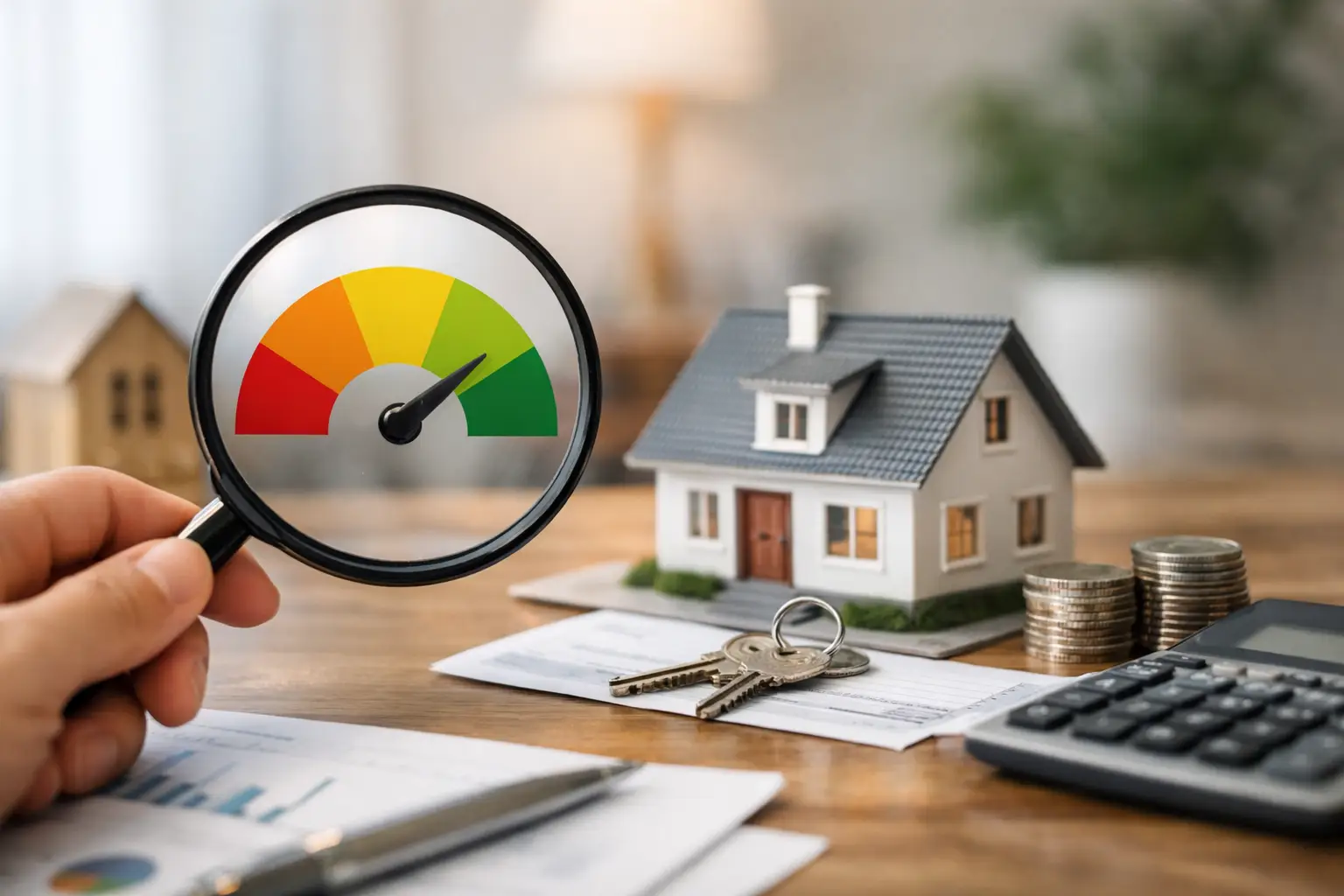
A 680 borrower financing $400,000 at 6.75% instead of a 740 borrower at 6.375% faces a payment difference of about $103 a month on principal and interest alone. Over five years, that is roughly $6,180. When people ask what credit score mortgage approval requires, that monthly gap is usually the real question behind it.
By Duane Buziak, Mortgage Maestro, NMLS#1110647
In Charlottesville and Albemarle County, that question matters because home prices are not small. Zillow data has Albemarle County’s typical home value around the mid-$500,000s, and many buyers near Crozet, Earlysville, and the urban ring around UVA are shopping well above entry-level price points. A modest credit score improvement can change pricing, down payment options, reserve expectations, and whether a loan works cleanly at all.
What credit score mortgage approval usually needs
There is no single universal score for every mortgage. The real answer depends on the loan type, down payment, debt-to-income ratio, cash reserves, property type, and whether the file has compensating strengths like stable income or low overall debt.
For most borrowers, these are the practical starting points lenders and investors commonly use:
| Loan type | Common minimum score range | Typical down payment | Notes | |—|—:|—:|—| | Conventional | 620+ | 3% to 5%+ | Better pricing usually starts closer to 680, then improves again at 720 and 740+ | | FHA | 580+ | 3.5% | Some lower-score scenarios exist with higher down payments, but 580 is the common benchmark | | VA | 580 to 620+ | 0% possible | VA itself does not set one universal lender minimum, but overlays often do | | USDA | 640+ common | 0% possible | Automated approval often works best at 640+ | | Jumbo | 680 to 720+ | 10% to 20%+ | Reserve requirements are usually stricter | | DSCR / non-QM | 620 to 680+ common | Varies | Pricing and documentation flexibility depend heavily on score |
Those are not promises, and they are not the same as approval. They are entry points. A 620 conventional file with high card balances and a 49% debt ratio is very different from a 620 file with strong reserves and a lower payment shock.
For conforming loans in 2025, the baseline one-unit limit in most areas is $806,500. That matters for buyers in the Charlottesville market because many homes still fit inside conforming territory, where credit scoring tends to have clearer pricing tiers than jumbo lending. Fannie Mae’s current loan limits are published at https://www.fanniemae.com.
Why your score matters beyond approval
The biggest mistake buyers make is treating credit score as a yes-or-no gate. It is also a pricing tool.
A mortgage applicant with a 760 score may qualify for similar loan programs as someone with a 660 score, but often with lower risk-based pricing adjustments, better mortgage insurance terms, or more flexibility on reserves. That can affect both monthly payment and cash to close.
Closing costs in this market often run around 2% to 5% of the loan amount, depending on prepaid taxes, homeowner’s insurance, discount points, and title charges. On a $450,000 purchase with 10% down, that can easily mean roughly $8,100 to $20,250 in addition to down payment. A lower score may not change every fee, but it can increase the cost of rate options.
What credit score mortgage programs look for by loan type
Conventional loans
Conventional loans usually start at 620, but that is not where they become most efficient. In practice, the pricing breakpoints borrowers feel most often are 680, 700, 720, and 740-plus.
If you are buying a primary residence in Albemarle County and putting 3% to 5% down, conventional financing can be attractive because private mortgage insurance may eventually be removed. But conventional is less forgiving than FHA on weaker credit files, especially if your debt-to-income ratio is already stretched.
FHA loans
FHA is often the practical answer for buyers with bruised credit or limited down payment. The standard benchmark is 580 for 3.5% down, with mortgage insurance required. HUD’s FHA guidance is available at https://www.hud.gov.
FHA can work well for first-time buyers near Charlottesville who have solid income but higher utilization on revolving debt. The trade-off is that the mortgage insurance structure can make FHA more expensive over time than conventional if your score later improves.
VA loans
VA financing is one of the strongest products available for eligible veterans and service members because it can allow zero down, no monthly mortgage insurance, and flexible underwriting. The Department of Veterans Affairs does not publish one universal minimum score for every lender, but many lenders use overlays, often in the 580 to 620 range. Official VA housing information is at https://www.va.gov.
For military households relocating to the area or moving out from rental housing near Seminole Trail or Pantops, VA can outperform conventional even when the score is not perfect. The key is that the full credit picture still matters, not just the number.
USDA loans
USDA can be excellent for eligible rural areas surrounding Charlottesville, where zero-down financing may be available. While manual underwrites can go lower, a 640 score often helps with smoother automated approval.
Jumbo and non-QM loans
Once loan amounts rise above conforming limits, score expectations usually rise too. Jumbo borrowers often need 680 to 720 or higher, plus stronger reserves. Six to twelve months of reserves is common, and some higher-balance loans ask for more.
Bank statement and other non-QM products can help self-employed borrowers, but lower scores usually bring steeper pricing. That trade-off is worth understanding before choosing flexibility over cost.
Local context in Charlottesville and Albemarle County
In a market where many purchase prices land between $400,000 and $700,000, small credit shifts can materially change affordability. If Albemarle County values remain around the mid-$500,000 range, a buyer putting 5% down may be financing more than $500,000 once taxes, insurance, and payment comfort are considered.
That is why prequalification should not be based on guesswork. Soft-pull prequalification can give a realistic starting point without the same impact concerns buyers often associate with a hard inquiry. For households comparing homes near downtown Charlottesville, north of Rio Road, or out toward Crozet, knowing the score-sensitive payment range early helps avoid shopping at the wrong price point.
6-step roadmap if your score is not where you want it
- Check the actual middle mortgage score, not a consumer app estimate. Mortgage scoring models often differ from free educational scores.
- Review revolving utilization. Paying cards down below 30%, and often below 10%, can help faster than many borrowers expect.
- Avoid opening new accounts before applying. New debt can hit both score and debt ratio.
- Fix reporting errors quickly. Late payments, duplicate accounts, or incorrect balances should be disputed with documentation.
- Ask which loan type fits your current profile. FHA, VA, USDA, conventional, and non-QM do not treat the same score the same way.
- Re-run the numbers before making an offer. A 20- to 40-point change can alter rate options, monthly payment, and cash to close.
Comparison: local borrowers versus national-style lenders
A borrower shopping with a brokerage model often gets broader program visibility than with a single retail lender. That matters when your score falls into a gray zone.
| Lender style | Strength | Potential trade-off | |—|—|—| | Local broker | More program flexibility across investors | Options vary by lender partner and file profile | | Big direct lender like Rocket | Strong digital process | Less localized guidance on property and market nuance | | Regional retail lender like Movement or Atlantic Coast | Familiar branch model | Usually fewer product paths than a broad broker channel | | Specialized VA-focused lender like Veterans United | Strong VA focus | May not be as flexible if borrower needs side-by-side alternatives |
This is where score strategy matters. A 640 borrower is not just a 640 borrower. One lender may steer that file toward FHA, while another may find a workable conventional or VA structure depending on assets, reserves, and property use.
FAQ
Is 620 a good enough credit score for a mortgage?
Yes, often for conventional entry-level qualification and commonly for several other loan types, but pricing may be meaningfully better above 680.
What is the minimum credit score for FHA?
580 is the common benchmark for 3.5% down, though lender overlays and full-file factors still apply.
Can I get a VA loan with bad credit?
Sometimes, yes. VA is flexible, but most lenders still apply their own minimum score standards and review the full credit history.
Does a higher score always mean a lower rate?
Usually better pricing, but not always a dramatically lower note rate by itself. Loan-to-value, occupancy, reserves, and discount points also matter.
What credit score do I need for a jumbo mortgage?
Many jumbo programs start around 680 to 720, with stronger reserves and larger down payments than conforming loans.
Will checking my credit for prequalification hurt my score?
A soft-pull prequalification may avoid the same impact concerns as a traditional hard inquiry, depending on the process used.
Can I buy with a low score if I have a big down payment?
Sometimes. More down payment can offset risk, but minimum score rules still apply by program and lender.
How much cash reserves do I need?
For many standard primary residence loans, reserves may be minimal or not required. Jumbo, investment, and some non-QM programs may require 6 to 12 months or more.
The useful question is not just what credit score mortgage approval takes. It is what score gets you the right payment, the right loan, and the least friction for the house you actually want. In a market like ours, that is where smart planning beats guesswork.
This article is for educational purposes only and does not constitute financial or legal advice.
Duane Buziak, Mortgage Maestro | NMLS: 1110647 | Licensed VA/TN/GA/FL | VA Broker of the Year 2024-2025 | Top 1% Nationwide | Coast2Coast Mortgage | (804) 212-8663.