By Duane Buziak, Mortgage Maestro, NMLS#1110647
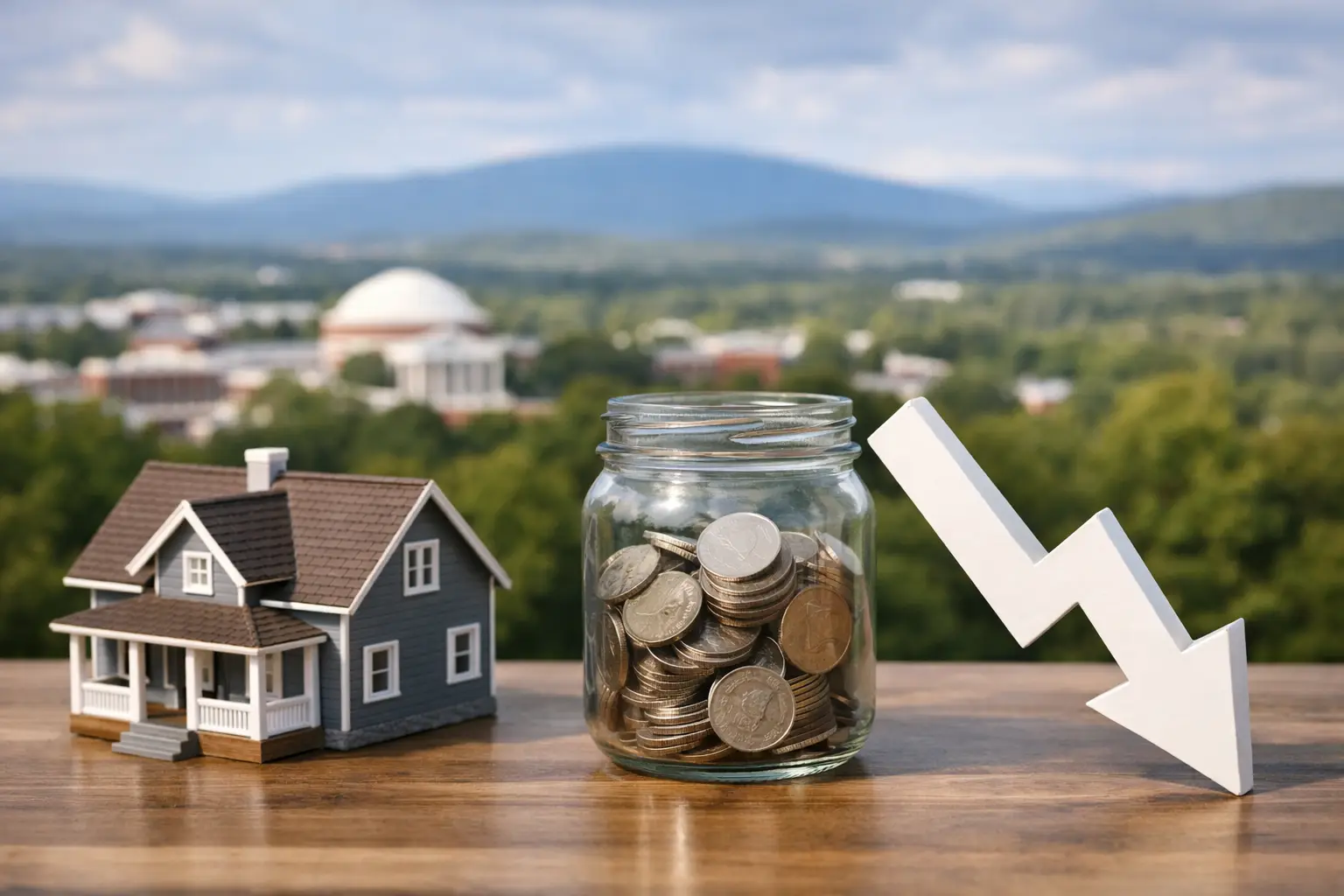
On a $450,000 home with 10% down, the loan amount is $405,000. If a 30-year fixed rate moves from 7.00% to 6.50%, principal and interest falls from about $2,694 to $2,560 per month – a savings of roughly $134 monthly, or about $8,040 over five years before taxes, insurance, and HOA dues. That is why the question many buyers keep asking around Pantops, Crozet, and north of Hydraulic is simple: are mortgage rates dropping Charlottesville buyers can actually benefit from, or are we just seeing short-term noise?
The honest answer is yes, rates have shown periods of easing, but not in a straight line and not always enough to change affordability overnight. Mortgage rates are driven less by the Federal Reserve headline and more by bond market expectations, inflation data, labor reports, and lender pricing margins. For local buyers, the practical question is not whether rates are dropping in theory. It is whether a given rate drop meaningfully changes the payment on the price range you are shopping.
Are mortgage rates dropping Charlottesville buyers should watch?
Rates can drift lower for a few weeks and still remain elevated compared with the ultra-low period many homeowners remember. That matters in Albemarle County, where median home values remain high relative to incomes. Recent market trackers have kept Charlottesville-area prices resilient, with Albemarle County median listing or sale figures often hovering in the mid-$500,000s depending on source and month, while the City of Charlottesville can print differently due to lower inventory and neighborhood mix. Buyers should verify current local figures through sources such as https://www.zillow.com/home-values/ and https://www.realtor.com/realestateandhomes-search/Albemarle-County_VA/overview.
A modest rate decline helps, but home prices, taxes, insurance, and available inventory still shape the decision. On a $550,000 purchase with 5% down, a quarter-point rate drop may save around $85 to $95 per month. Useful, yes. Transformational, not always. In contrast, if a buyer improves credit from 679 to 720 and qualifies for better pricing, the combined impact can be larger than waiting for the market alone.
What is pushing rates right now?
Three forces matter most. First is inflation. If inflation cools, mortgage-backed securities often improve and rates may follow. Second is Treasury yield movement, especially the 10-year. Third is lender risk appetite, which affects pricing for lower down payment loans, cash-out refinances, condos, and non-QM products.
For Charlottesville buyers, there is also a local timing issue. Inventory in spring and early summer can push buyers into more competition around UVA-adjacent areas and family neighborhoods in Albemarle. If rates dip at the same time listings increase, demand can firm up quickly and offset some affordability gains through higher prices or multiple-offer pressure.
A Charlottesville payment snapshot
| Scenario | Purchase Price | Down Payment | Loan Amount | Rate | Est. Principal and Interest | |—|—:|—:|—:|—:|—:| | Entry move-up buyer | $450,000 | 10% | $405,000 | 7.00% | $2,694 | | Same loan, lower rate | $450,000 | 10% | $405,000 | 6.50% | $2,560 | | Albemarle median-style range | $575,000 | 20% | $460,000 | 7.00% | $3,060 | | Same loan, lower rate | $575,000 | 20% | $460,000 | 6.50% | $2,907 | | Higher-balance local buyer | $800,000 | 10% | $720,000 | 7.00% | $4,790 | | Same loan, lower rate | $800,000 | 10% | $720,000 | 6.50% | $4,551 |
These are payment illustrations for principal and interest only. Taxes, homeowners insurance, mortgage insurance if applicable, and HOA dues are separate.
Why waiting can help – and when it can hurt
If rates are trending down, waiting can make sense for buyers with flexible timing, improving credit, or cash reserves that are still being built. It can also help refinance candidates who already own and do not need to move immediately.
But waiting carries a real trade-off in Charlottesville. If the right home appears near schools, commuting routes, or established neighborhoods, a lower rate six months from now may not offset a higher purchase price or another year of rent. A buyer paying $2,200 monthly in rent gives up $13,200 over six months while waiting. If rates only fall enough to save $100 to $150 a month, the math is not always favorable.
That is why strategy matters more than rate watching alone.
Credit, loan type, and local loan limits matter more than headlines
A conventional buyer with a 740 score, 20% down, and strong reserves will usually price differently from a 640 score FHA buyer with 3.5% down. Both can absolutely buy, but they should not expect the same quoted rate.
For conventional financing, many lenders want at least 620, while stronger pricing often starts around 680 to 740 depending on loan-to-value and property type. FHA can work starting at 580 in many cases with 3.5% down, subject to full approval. VA loans can be especially strong for eligible veterans and active-duty borrowers, often with no down payment requirement, though individual lender overlays still apply. Official program guidance can be reviewed at https://www.hud.gov/ and https://www.va.gov/housing-assistance/home-loans/.
The 2025 standard conforming loan limit for one-unit properties in most areas is $806,500, which is relevant for many higher-price Charlottesville and Albemarle purchases. Above that, jumbo pricing and reserve requirements can change. For jumbo loans, borrowers may need 6 to 12 months of reserves depending on occupancy, credit, and asset profile. Even on conventional loans, 2 to 6 months of reserves can strengthen an approval for borderline debt-to-income cases.
Closing costs also deserve realism. In this market, a purchase borrower might commonly see roughly 2% to 4% of the price in total closing costs and prepaid items, though the exact number can vary based on taxes, escrows, discount points, and title charges.
How Charlottesville buyers should act if rates are drifting down
1. Start with a soft-pull prequalification
This lets you test affordability without unnecessarily impacting credit. If your target payment is $2,800, the right question is what price, down payment, and loan structure fit that payment today.
2. Compare the real APR and total cash to close
A lower note rate is not always cheaper if it comes with heavy discount points. Ask what the breakeven period is. If you may move or refinance in three years, paying points may not pencil out.
3. Match the loan to your situation
Conventional is not automatically best. FHA can outperform conventional for some buyers with moderate credit. VA can be the strongest option for eligible borrowers. Self-employed buyers may need bank statement or non-QM analysis if tax returns do not reflect true cash flow.
4. Watch both rates and inventory
A one-eighth drop in rate matters less than having no suitable homes to buy. In neighborhoods where inventory is thin, locking a reasonable rate on the right property can beat chasing a perfect market moment.
5. Negotiate seller help where possible
If rates are only modestly lower, a seller credit can reduce upfront cost or buy down the rate. That can matter more than waiting for broad market changes.
6. Revisit the file if your credit or assets improve
Paying down revolving balances, documenting bonus income properly, or seasoning reserves can change pricing faster than the market does.
How local and national lenders differ when rates move
Large retail lenders and call-center brands such as Rocket, Veterans United, Freedom, or CrossCountry may offer convenience and marketing reach. Regional and local players such as CapCenter, First Heritage, Atlantic Coast, NFM, CMG, Alcova, C&F, Movement, UWM-linked brokers, or Embrace can differ on fees, overlays, responsiveness, and loan menu.
When rates are volatile, execution matters. A buyer in Charlottesville often benefits from a lender or broker who understands local appraisals, property mix, and timing around contract deadlines. The lowest advertised rate does not always survive inspection negotiations, condo review, self-employment documentation, or a tight settlement calendar.
FAQ
Are mortgage rates dropping in Charlottesville right now?
They may be easing in periods, but usually with daily volatility. Buyers should track actual loan pricing, not broad news headlines.
Should I wait for rates to fall before buying?
It depends on your rent, cash reserves, and whether local home prices are still rising in your target area.
What credit score gets the best mortgage pricing?
Many borrowers see meaningfully stronger conventional pricing above 700, with another improvement tier often around 740 or higher.
Can I refinance later if I buy now?
Yes, if rates improve and you qualify. The trade-off is paying closing costs again, so the future savings should justify the refinance.
What are closing costs around Charlottesville?
A common working estimate is about 2% to 4% of the purchase price including lender fees, title charges, and prepaid taxes and insurance.
Are jumbo loans common here?
They can be, especially for higher-end Albemarle purchases. Once the loan amount exceeds conforming limits, reserve and pricing rules usually tighten.
Is FHA or conventional better for first-time buyers?
Neither is universally better. FHA can help with lower scores or higher debt ratios, while conventional can reduce long-term mortgage insurance costs for stronger files.
This article is for educational purposes only and does not constitute financial or legal advice.
If you are watching rates from the sidelines, focus less on guessing the perfect week and more on building a file that can win when the right home appears. In Charlottesville, the best mortgage strategy is usually not the flashiest rate quote. It is the one that fits your budget, timeline, and neighborhood goals without surprises at the closing table.
Duane Buziak, Mortgage Maestro | NMLS: 1110647 | Licensed VA/TN/GA/FL | VA Broker of the Year 2024-2025 | Top 1% Nationwide | Coast2Coast Mortgage | (804) 212-8663.