
You found a home you love in Charlottesville or Albemarle County. You applied at your bank or credit union. And you got turned down for a conventional loan.
That rejection does not mean homeownership is off the table. It means you applied at the wrong place.
Conventional loans set a 620 minimum credit score, enforce strict debt-to-income ratios, and require W-2 income documentation that disqualifies a large share of real-world buyers. Self-employed professionals, UVA contract faculty, international researchers, real estate investors, and buyers who’ve had a recent credit event all run into this wall regularly. The bank says no, and the buyer assumes the door is closed.
It isn’t.
As an independent mortgage broker with access to 500+ lenders, I work with loan programs that retail banks and credit unions simply cannot offer. Where a bank has one set of guidelines, I have hundreds of investor options, including non-QM products, government-backed programs at their true published floors, and specialty programs built for exactly the buyers conventional underwriting rejects.
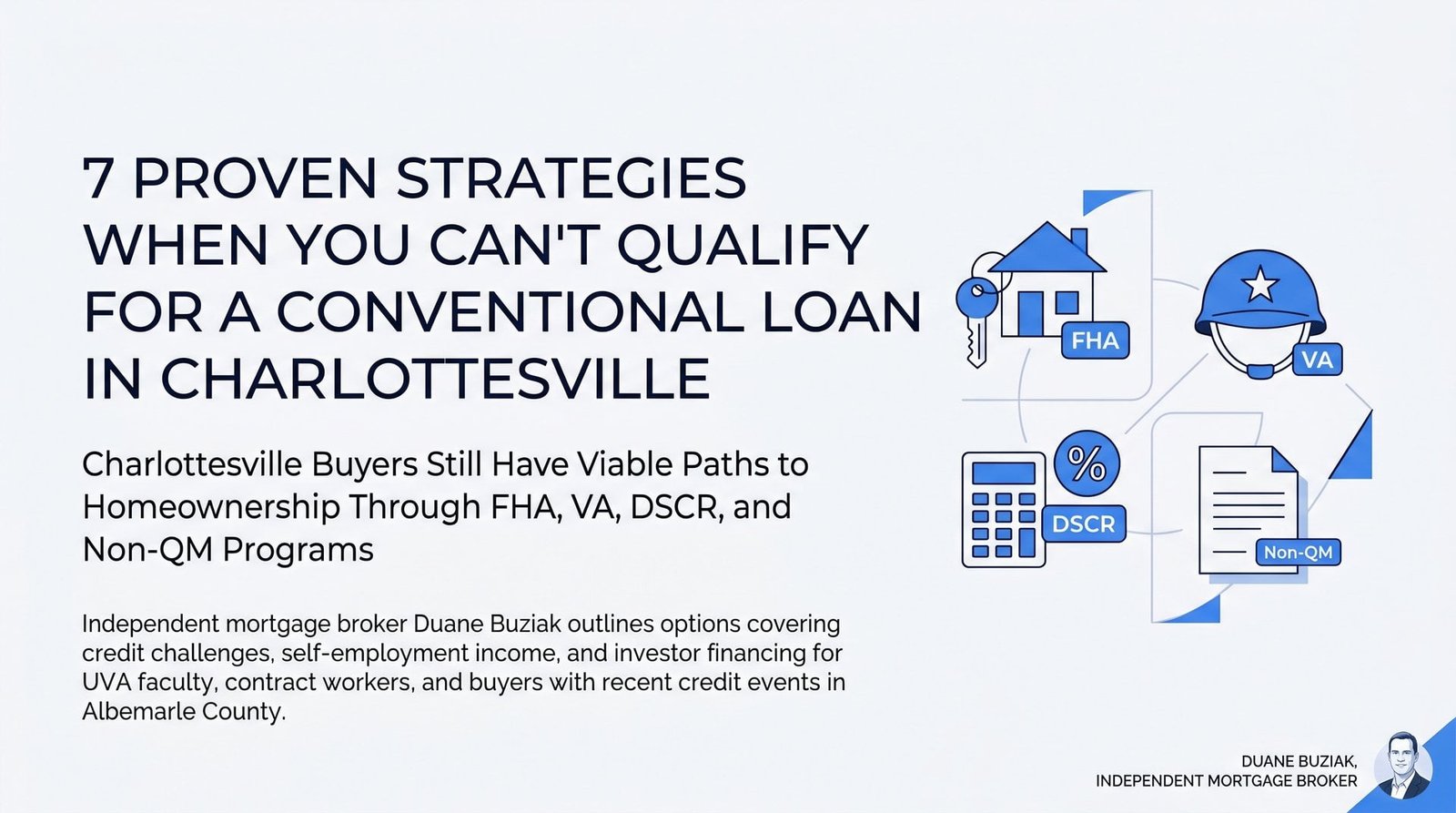
With Albemarle County’s median home price at $516,000 in 2026, there is real money on the line. A path forward exists for nearly every turned-down buyer. Below are seven specific strategies, each a real loan path, for buyers who’ve been told no by a conventional lender.
1. FHA Loans: The 580 Credit Score Path Most Banks Won’t Tell You About
The Challenge It Solves
You’ve been told you don’t qualify because your credit score falls below the bank’s threshold. What the bank likely didn’t tell you is that their threshold is not the law. It’s a policy choice. Retail banks and credit unions routinely apply overlays that push their internal FHA minimums to 620 or higher, effectively blocking buyers who qualify under actual HUD guidelines.
The Strategy Explained
According to HUD’s FHA Single Family Housing Policy Handbook (4000.1), FHA loans allow a minimum credit score of 580 with 3.5% down, and scores between 500 and 579 qualify with 10% down. These are real, published federal guidelines, not creative marketing. The difference between a bank overlay and the true HUD floor can be the difference between owning a home and renting indefinitely.
I access lenders who fund at the actual HUD floor, not inflated internal minimums. That’s a direct result of having 500+ lenders in the network rather than one set of in-house guidelines.
Implementation Steps
1. Pull a soft-credit review to confirm your current score and identify whether you fall in the 580-619 range that banks reject but FHA accepts.
2. Identify your down payment source. At 3.5% down on a $450,000 purchase, you need $15,750 plus closing costs. Down payment assistance programs like Dynamo DPA may cover part of this.
3. Run a full FHA pre-approval through a lender who funds at the true 580 floor. On a $450,000 purchase with 3.5% down, your FHA loan amount is approximately $434,250. At current program rates, that produces a principal and interest payment in a range your budget can model concretely before you make an offer.
4. Confirm the property meets FHA minimum property standards, which is standard practice on any FHA transaction.
Pro Tips
FHA mortgage insurance is a real cost: an upfront premium of 1.75% of the loan amount (financed into the loan) plus an annual premium. On a $434,250 loan, the upfront MIP adds roughly $7,599 to the loan balance. Know this going in. It’s still frequently the most accessible path for credit-challenged buyers, and it beats renting by a wide margin in most Charlottesville-area scenarios.
2. VA Loans Down to 500 FICO: Converting Military Turndowns Into Closings
The Challenge It Solves
Military buyers and veterans are among the most frustrated callers I receive. They’ve earned a VA benefit, they walk into a credit union or retail bank, and they get turned away because their score is 580 or 610. The lender cites a 620 or 640 minimum. The veteran assumes that’s the VA’s rule. It is not.
The Strategy Explained
According to VA.gov, the Department of Veterans Affairs sets no minimum credit score requirement for VA loans. The floor is created entirely by individual lenders through overlays. This means the same benefit that entitles a veteran to zero down payment and no private mortgage insurance is being blocked by a bank’s internal policy, not by the federal program itself.
I fund VA loans at 500 FICO. Zero down. No PMI. No conventional loan required. For a veteran purchasing at the Albemarle County median of $516,000, that’s a zero-down path into a home that a retail lender just told them was impossible.
Implementation Steps
1. Confirm VA eligibility with a Certificate of Eligibility (COE), which I can pull directly through VA systems during the pre-approval process.
2. Run a soft-pull credit review to establish the current score and identify any rapid rescore opportunities before submitting a full application.
3. Match to a VA investor in my network who funds at the actual score level, not an overlay floor.
4. Structure the offer with zero down on the purchase price. On a $516,000 purchase, that means financing the full amount (subject to VA funding fee, which can also be financed).
Pro Tips
VA loans at lower FICO scores may carry slightly higher rates than VA loans at 700+, but the combination of zero down and no PMI still produces a payment structure that outperforms most conventional alternatives for eligible buyers. Run the numbers side by side before assuming the rate differential makes it less attractive. For a deeper look at how this works locally, see our guide on using a VA loan in Charlottesville.
3. Bank Statement Loans for Self-Employed and 1099 Buyers
The Challenge It Solves
Conventional underwriting is built around W-2 income. If you’re self-employed, a 1099 contractor, or a business owner who legitimately writes off expenses, your tax returns show low taxable income by design. That’s smart tax strategy. But it kills a conventional loan application. The underwriter sees the net income on your Schedule C or 1040 and denies the file based on numbers that don’t reflect how you actually live.
The Strategy Explained
Bank statement loan programs replace tax returns with 12 to 24 months of personal or business bank statement deposits as the income documentation. The lender calculates an average monthly deposit figure and uses that to qualify you. No W-2. No tax returns. No employer verification.
This is a direct solution for Charlottesville business owners, UVA consulting faculty paid on 1099 arrangements, independent contractors in the area’s growing tech and healthcare sectors, and anyone whose real cash flow exceeds what their tax return shows.
Implementation Steps
1. Gather 12 to 24 months of bank statements, either personal, business, or both depending on program guidelines.
2. Calculate your average monthly deposits. Large one-time transfers or loan proceeds are typically excluded, so work with a lender who understands the nuances of the calculation.
3. Confirm the deposit average supports the debt-to-income ratio needed for your target purchase price. On a $516,000 purchase with 20% down, you’re financing roughly $412,800. Work backward from that payment to the income figure required.
4. Submit through a non-QM investor in my network who offers bank statement programs. These are not available at retail banks or most credit unions.
Pro Tips
Business bank statement programs typically apply an expense factor (often 50% for sole proprietors, lower for businesses with documented expenses) to the deposit average. Understand which calculation method your lender uses before assuming your deposit volume automatically qualifies you. For a broader look at loan options for self-employed homebuyers, I walk every bank statement borrower through this math before we submit.
4. DSCR Loans for Investment Property Buyers Who Don’t Qualify on Personal Income
The Challenge It Solves
Real estate investors frequently hit a wall when their personal income doesn’t support additional investment property financing. Conventional guidelines count existing mortgage payments against your DTI, and adding another property pushes the ratio past the limit. The investment opportunity is sound. The personal income picture is the problem.
The Strategy Explained
DSCR stands for Debt Service Coverage Ratio. The formula is straightforward: Net Operating Income divided by total debt service. A DSCR of 1.0 means the property’s income exactly covers its debt payments. Most DSCR lenders require a minimum of 1.20 to 1.25, meaning the property generates at least 20-25% more income than it costs to carry.
The critical advantage: DSCR loans require no W-2, no tax returns, and no personal employment verification. Qualification is based entirely on the property’s income potential, not the borrower’s personal income. This is the right tool for Charlottesville investors near UVA, short-term rental operators in Crozet, and buyers targeting properties in the Shenandoah region.
Implementation Steps
1. Identify the target property and establish its market rent or documented short-term rental income. For a long-term rental, use a lease or market rent appraisal. For short-term rentals, many DSCR lenders now accept Airbnb or VRBO income history.
2. Calculate the DSCR. Example: A Charlottesville investment property rents for $2,800/month. The PITIA (principal, interest, taxes, insurance, and HOA) on a $350,000 loan is approximately $2,200/month. DSCR = $2,800 / $2,200 = 1.27. That clears a 1.25 minimum.
3. Confirm credit score meets program minimums (typically 620-680 depending on the DSCR investor) and that the down payment meets LTV requirements (commonly 20-25% down for investment DSCR loans).
4. Submit through a DSCR-specific investor. For Charlottesville-area investors, see how DSCR loans work for local investment properties. This product does not exist at most retail banks.
Pro Tips
DSCR programs vary significantly by investor on short-term rental income treatment. If you’re buying a property you intend to operate as a short-term rental, confirm upfront that the lender accepts STR income in the DSCR calculation rather than requiring long-term market rent, which may produce a lower qualifying figure.
5. ITIN and Foreign National Loans for International Buyers Without a Social Security Number
The Challenge It Solves
Conventional loans require a Social Security number. That single requirement automatically excludes a meaningful segment of Charlottesville’s homebuying population: UVA’s international faculty, H-1B visa holders, visiting researchers, and foreign nationals who want to purchase property in the United States. A retail bank’s answer is almost always no. The correct answer is a different loan program.
The Strategy Explained
ITIN loan programs use an Individual Taxpayer Identification Number in place of an SSN. Foreign national programs use passport, visa documentation, and international credit history or asset verification. Neither requires U.S. citizenship or permanent residency. Both are real, funded loan products available through non-QM investors in my network.
UVA’s international faculty, researchers, and visiting scholars represent a meaningful portion of Charlottesville’s homebuying population. Many are here for multi-year appointments, earn strong incomes, and have every practical reason to own rather than rent. The conventional loan system simply wasn’t built for their documentation profile. These programs were.
Implementation Steps
1. Confirm the borrower’s documentation type: ITIN holder, H-1B visa, O-1 visa, or foreign national without U.S. presence. The loan program and documentation requirements differ by category.
2. Gather income documentation appropriate to the program. ITIN borrowers typically provide two years of ITIN-filed tax returns or bank statements. Foreign nationals typically provide bank statements, asset documentation, and an employment letter or equivalent.
3. Establish a credit profile. For buyers with no U.S. credit history, some programs accept international credit reports or use alternative credit documentation such as utility payment history and rental history.
4. Structure the transaction with the appropriate down payment. ITIN and foreign national programs typically require 20-30% down and may carry higher rates than conventional products, reflecting the non-QM risk profile.
Pro Tips
For H-1B and other visa holders with established U.S. credit history and W-2 income from a U.S. employer, conventional loan eligibility may actually exist despite the foreign national status. Run a full review before defaulting to a non-QM product in Virginia. The right program depends on the full documentation picture, not just the visa type.
6. Asset Depletion Loans When You Have Wealth but Low Monthly Income
The Challenge It Solves
This is one of the most frustrating conventional loan denials to receive: a buyer with a substantial investment portfolio, retirement accounts, or liquid assets gets turned down because their monthly W-2 income is low or nonexistent. A retired UVA professor with $1.5 million in a brokerage account has real wealth. Conventional underwriting doesn’t care. It looks at monthly income, finds a small Social Security check, and declines the application.
The Strategy Explained
Asset depletion, sometimes called asset dissipation, is a qualifying method that converts verified liquid assets into a calculated monthly income stream. The standard calculation divides eligible assets by the remaining loan term in months. A borrower with $1,200,000 in liquid assets applying for a 30-year loan would have those assets divided by 360, producing a calculated monthly income of $3,333 for qualifying purposes, in addition to any actual income they receive.
This is a documented loan structure recognized in both some Fannie Mae guidelines and non-QM investor programs. It’s the right tool for retired UVA professors, trust beneficiaries, high-net-worth move-up buyers, and anyone whose balance sheet tells a better story than their income statement.
Implementation Steps
1. Document all eligible liquid assets: checking, savings, brokerage accounts, IRA/401(k) balances (typically at a haircut of 60-70% for retirement accounts to account for tax liability and early withdrawal penalties).
2. Calculate the asset depletion income using the lender’s specific formula. Different investors apply different methodologies, so confirm the exact calculation before building your qualification case.
3. Combine asset depletion income with any actual income (Social Security, pension, rental income, dividends) to arrive at total qualifying income.
4. Confirm the combined income supports the debt-to-income ratio for the target loan amount. On a $400,000 loan, the monthly payment at current program rates requires a qualifying income level that asset depletion can often bridge.
Pro Tips
Not all asset types qualify equally. Funds in a 401(k) or IRA are typically discounted before the depletion calculation. Assets pledged as collateral elsewhere may be excluded. A thorough asset inventory before application prevents surprises in underwriting. I review the full asset picture on the first call.
7. NoTouch Credit and Rapid Rescore: Qualifying Faster Than You Think
The Challenge It Solves
Many buyers who’ve been turned down aren’t far from qualifying. They’re 20 to 40 points short of the threshold they need. The instinct is to wait months and hope the score improves on its own. The reality is that targeted, fast action can close that gap in days, not months. But most buyers don’t know where to start, and they’re afraid that checking their credit will make things worse.
The Strategy Explained
NoTouch Credit is a soft-pull pre-approval review that identifies your current credit profile without triggering a hard inquiry and without impacting your score. It gives me a clear picture of exactly where you stand and, more importantly, exactly what needs to move to get you to your target score.
Rapid rescore is a lender-initiated process that updates your credit file at the bureau level within three to five business days after you take corrective action, such as paying down a credit card balance or resolving a reporting error. Where a normal bureau update might take 30 to 60 days, rapid rescore compresses that timeline dramatically.
Combined, these two tools create an action plan that can move a buyer from denied to approved faster than any calendar-based credit repair approach.
Implementation Steps
1. Request a NoTouch soft-pull review. No hard inquiry, no score impact, full picture of your current profile across all three bureaus.
2. Identify the highest-leverage actions. Common quick wins include paying down revolving balances below 30% utilization, disputing reporting errors, and removing small collection accounts that may be deletable.
3. Execute the corrective actions. For balance paydowns, this requires available funds. For reporting errors, it requires documentation. I walk through each item specifically.
4. Request rapid rescore through the lender channel after corrective actions are confirmed. Updated scores typically return in three to five business days.
5. Re-run the pre-approval with the updated score and confirm qualification under the target loan program.
Pro Tips
Because I’m available 24/7, this process doesn’t have to wait for banker hours. An action plan can be in your hands the same evening you call, before the bank that turned you down opens the next morning. Speed matters in the Charlottesville market. Don’t lose a property to a timeline problem that’s solvable in a week. Understanding what credit score you need for a mortgage is the first step toward a clear action plan.
Your Path Forward Starts With One Call
A conventional loan denial is a lender problem, not a buyer problem. The bank or credit union you applied at has one set of guidelines. I have access to over 500 lenders, each with different programs, overlays, and risk appetites. The path forward almost always exists. The question is which path fits your specific situation.
Here’s a quick summary of the seven strategies covered above:
FHA to 580 (or 500): For buyers with credit scores below the bank’s overlay floor who qualify under actual HUD guidelines.
VA to 500 FICO: For veterans and military buyers blocked by lender overlays, not by the VA benefit itself.
Bank Statement Loans: For self-employed buyers, 1099 contractors, and UVA consulting faculty whose tax returns understate their real income.
DSCR Loans: For real estate investors whose personal income doesn’t support conventional qualification but whose target property cash-flows.
ITIN and Foreign National Programs: For UVA international faculty, H-1B holders, and foreign nationals excluded by the SSN requirement.
Asset Depletion: For retirees and high-net-worth buyers with substantial liquid assets and low monthly income.
NoTouch Credit and Rapid Rescore: For buyers who are close to qualifying and need a targeted, fast action plan rather than a waiting game.
Every one of these is a real loan program funded through my network. None of them are available at the retail bank that turned you down.
I’m available 24/7, including evenings, weekends, and holidays, because that’s when real buyers have real questions. The first call is a conversation, not a commitment. We identify your situation, match it to the right program, and build a clear path to the closing table.
Call or text me at (434) 443-7028, or visit Cavalier Mortgage to get started today. Let’s turn that denial into a closing.