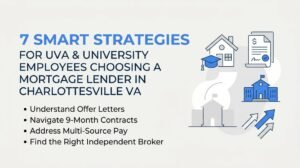
Charlottesville’s housing market doesn’t wait. Homes near UVA, Belmont, and the Route 29 corridor routinely go under contract within days of listing, and sellers here have learned to distinguish between buyers who are genuinely ready and buyers who are still figuring out their financing. If you’re a UVA faculty member relocating from out of state, a first-time buyer eyeing Crozet’s new construction, or a move-up buyer trading a townhome for acreage in Albemarle County, a generic national homebuying checklist will not serve you well in this market.
The Charlottesville area has its own dynamics: price points that frequently push toward or past conforming loan limits, rural eligibility zones that affect USDA access, and a competitive offer environment where the credibility of your pre-approval letter matters as much as your purchase price. Sellers’ agents know the difference between a retail bank commitment letter and a pre-approval from an independent broker who has the program depth to actually close.
This guide is the local playbook I use with every buyer I work with across Charlottesville, Albemarle County, Crozet, Waynesboro, and Staunton. It covers every step: from reviewing your credit without a hard inquiry, to matching your profile to the right loan program, to clearing conditions and wiring funds to title. Follow it in sequence, and you’ll walk into this market with a plan that works.
By Duane Buziak | Cavalier Mortgage | NMLS #1110647
Step 1: Know Your Numbers Before You Talk to Anyone
The biggest mistake buyers make is starting the conversation with a broker or bank before they know their own financial picture. You end up reactive instead of strategic, and in a market like Charlottesville, that costs you offers.
Start by pulling your own credit report at AnnualCreditReport.com. This is a soft pull. It leaves no footprint on your credit file and does not affect your score. You’ll see the same accounts and payment history that any broker will review. Look for errors, unfamiliar accounts, or collections you weren’t aware of. Disputing errors before you apply can meaningfully move your score.
Understanding the difference between a soft credit pull mortgage review and a hard inquiry matters here. When you visit a retail bank and fill out an application, they typically run a hard pull immediately, which can drop your score by several points. Cavalier Mortgage offers a mortgage pre-approval without hard pull during the initial consultation phase, so your score is protected while you’re still evaluating your options.
Beyond your credit score, there are four numbers you need to know cold before any broker conversation:
Credit score range: Know whether you’re above or below 580, 620, 640, and 700. Each threshold opens or closes specific programs and affects pricing. If you’re unsure which scoring model your broker uses, read more about whether your lender is using VantageScore 4.0, which can differ from the FICO models used in mortgage underwriting.
Monthly gross income: This is your income before taxes. For W-2 employees, it’s straightforward. For self-employed buyers or UVA faculty on non-standard contracts, it requires more documentation, but the starting point is the same: what does your gross monthly income look like on paper?
Total monthly debt payments: Add up every minimum payment that shows on your credit report: car loans, student loans, credit cards, personal loans. This number directly determines how much house you can qualify for. If your score needs work before you apply, credit restoration for home buyers is a resource worth reviewing before you start the process.
Liquid assets: What do you have available for a down payment and reserves? Reserves matter because most loan programs require you to have funds remaining after closing, not just enough to cover the down payment and closing costs.
One more thing to understand before you start: Charlottesville and Albemarle County median home prices mean many buyers are approaching or exceeding the conforming loan limit set annually by the FHFA. The 2026 conforming loan limit is a number every Charlottesville buyer should know, because crossing it moves you from conventional pricing into jumbo territory, which has different qualification requirements and rate structures.
Pitfall to avoid: Do not apply to multiple retail banks at the same time. Each application triggers a hard pull, and multiple hard inquiries in a short window can drop your score enough to push you out of a program you otherwise qualified for.
Success indicator: You can state your credit score range, estimated down payment amount, total monthly debt load, and available liquid assets before you make your first broker call.
Step 2: Choose the Right Loan Program for Your Situation
Charlottesville buyers have access to more loan programs than most markets, but only if they’re working with a broker who can actually offer them. A retail bank typically carries three to five products. As an independent broker, Cavalier Mortgage shops 500+ wholesale lenders simultaneously, which means program fit is the starting point, not rate headline. For a comprehensive overview of what’s available, see the best mortgage programs Charlottesville buyers need.
Here’s how to match your profile to the right program:
VA Loan: If you’re an eligible veteran, active-duty service member, or surviving spouse, this is almost always your strongest option. Zero down payment, no private mortgage insurance, and Cavalier Mortgage offers VA loans down to a 500 FICO score. The VA itself sets no minimum credit score; lender overlays vary, and the 500 FICO floor here is a real program, not a marketing line. VA loans are particularly relevant for buyers in the Charlottesville/Fort Belvoir commuter corridor and throughout the region.
FHA Loan: A strong option for first-time buyers and those with credit scores in the 580–640 range. FHA requires 3.5% down at 580+ FICO, and 10% down for scores between 500 and 579, per HUD guidelines. FHA pricing tends to work well in the Waynesboro and Staunton price ranges, where purchase prices are more moderate. Learn more about FHA loans in Virginia and how they apply to this market.
USDA Loan: Zero down payment for eligible rural areas. Parts of Albemarle County and the outer edges of Crozet have historically qualified, but USDA eligibility boundaries shift as population grows. Some Crozet areas have transitioned out of USDA eligibility in recent years. Always verify current boundaries at the USDA eligibility map before building your strategy around this program.
Conventional Loan: Best pricing for buyers with 700+ FICO and 5–20% down. For a detailed breakdown of how conventional financing works in this market, read the conventional loan Charlottesville guide. Charlottesville’s price points frequently push into jumbo territory above the conforming loan limit, which requires a different underwriting approach and typically a stronger credit and asset profile.
Non-QM, Bank Statement, and ITIN Loans: For self-employed buyers, UVA international faculty, or buyers with non-traditional income documentation, these programs exist precisely because standard W-2 underwriting doesn’t capture the full picture. Cavalier Mortgage offers ITIN and foreign national loan programs that most retail banks simply don’t carry. If you’ve been told you can’t qualify for a conventional loan, read this before you give up.
Down Payment Assistance: Dynamo DPA and Turbo DPA programs can layer with FHA or conventional loans to reduce or eliminate the out-of-pocket down payment requirement. Eligibility depends on income, purchase price, and property location, but these programs are actively available to Charlottesville-area buyers and worth evaluating before assuming you need to save a full down payment.
DSCR and Asset Depletion Loans: For investors purchasing rental property near UVA, DSCR (Debt Service Coverage Ratio) loans qualify based on the property’s rental income rather than the borrower’s personal income. Asset depletion programs can help buyers with significant savings but limited monthly income documentation.
Success indicator: Before you tour a single home, you’ve matched your credit profile, income type, down payment, and property target to a specific loan program. That match drives every subsequent step.
Step 3: Get Pre-Approved the Charlottesville Way
In this market, a pre-approval letter is not a formality. It’s your entry ticket to competitive offers. Listing agents in Charlottesville and Albemarle County know the difference between a vague pre-qualification letter and a conditional pre-approval tied to a specific loan program and purchase price. The CFPB defines this distinction clearly: pre-qualification is an estimate based on self-reported information; pre-approval involves verified documentation and underwriting review.
A strong pre-approval requires: 30 days of pay stubs, two years of W-2s or tax returns (self-employed buyers need two years of returns plus a year-to-date profit and loss statement), two months of bank statements, and a government-issued ID. The more complete your file, the stronger the letter.
Cavalier Mortgage offers a no hard inquiry mortgage pre-approval process through an initial consultation using a soft pull mortgage broker review. This means your credit is protected during the shopping phase. You get a clear picture of your qualification before a hard inquiry is ever run. For buyers comparing options across brokers, this matters: every unnecessary hard pull costs you points you may need.
Here’s how the math works in practice. Note: rates move daily and are not published here because any number would be stale within hours. For live wholesale rate pricing built around your specific profile — FICO score, loan program, purchase price, and down payment — request a real-time rate or call Duane at (434) 443-7028. That said, the structure of the calculation is worth understanding:
Buyer profile: $95,000 gross annual income = $7,917/month gross. Existing monthly debt: $450 (car payment + student loan). At a 43% DTI ceiling: $7,917 × 0.43 = $3,404 total monthly debt allowed. Subtract existing debt: $3,404 − $450 = $2,954/month available for housing (PITI: principal, interest, taxes, insurance).
The purchase price that $2,954/month in PITI supports depends entirely on the live rate at the time of your application, your down payment, property tax rate, and whether PMI applies. A lower rate means more purchasing power; a higher rate means less. This is why your first call to Cavalier Mortgage — using the soft-pull process — gives you an accurate, current picture rather than a number that may already be wrong by the time you read it. For a deeper understanding of what’s driving rate movement in this market, see mortgage rates in Charlottesville VA.
For a deeper look at how this process unfolds, read the mortgage process guide for Charlottesville. And when you’re ready to understand rate structures, here’s how rates work at Cavalier Mortgage.
Pitfall to avoid: Pre-qualification is not pre-approval. Do not submit offers with a pre-qualification letter in a competitive Charlottesville market. Sellers and their agents will notice, and it weakens your position immediately.
Success indicator: You hold a conditional pre-approval letter tied to a specific loan program, loan amount, and purchase price. It’s ready to attach to an offer the moment you find the right property.
Step 4: Search Strategically in Charlottesville’s Neighborhoods
Not all of Charlottesville is the same market, and the neighborhood you target affects your loan program options, tax obligations, and long-term equity trajectory. Understanding the submarket dynamics before you start touring saves time and prevents costly mismatches between the home you want and the loan you can use. For a detailed breakdown of where buyers are finding the best value, see the guide to best Charlottesville neighborhoods for homebuyers.
Charlottesville city vs. Albemarle County: These are two separate jurisdictions with different real property tax rates, school districts, and price-per-square-foot dynamics. Albemarle County’s real estate tax rate is publicly available at albemarle.org. City of Charlottesville rates differ. Know which jurisdiction a property falls in before you calculate your monthly PITI. For a detailed look at financing in the county, see the Albemarle County home loans page.
Key submarkets to understand:
UVA/Barracks Road area: Walkable, high demand, limited inventory. UVA’s presence drives consistent housing demand near the university. Homes here move quickly and often above list price. Price points regularly push toward or past conforming loan limits.
Belmont and Woolen Mills: Urban feel with rising prices. Attractive to buyers who want walkability and proximity to downtown Charlottesville. Inventory is tight and competition is real.
Crozet: New construction, family-oriented, strong school district appeal. Important note: as Crozet has grown, some areas have transitioned out of USDA rural eligibility. Verify current USDA boundaries at the USDA eligibility map before assuming zero-down access in this submarket.
Waynesboro and Staunton: More affordable price points, commuter distance from Charlottesville, and stronger VA and USDA eligibility. These markets offer more purchasing power per dollar and are worth serious consideration for buyers with flexible commute requirements. For a full program breakdown in this corridor, see home loans in Waynesboro VA.
Work with a buyer’s agent who understands how to write competitive offers in this environment. Cavalier Mortgage maintains a network of experienced local agents, and you can find referrals on the Realtors page. A strong agent and a credible pre-approval letter together are your most effective competitive tools.
Pitfall to avoid: Falling in love with a home before confirming loan program eligibility for that specific property. Rural USDA zone status, FHA and VA condo warrantability, and flood zone designation all affect which programs you can use on a given address. Confirm program eligibility on the property before you get emotionally invested.
Success indicator: You have a defined target neighborhood or set of submarkets, a purchase price tied to your pre-approval, and a buyer’s agent engaged before you begin active property searches.
Step 5: Make an Offer and Navigate the Contract Period
Getting under contract in Charlottesville requires both a strong offer and a financing team that can execute. These two things are not independent of each other. Listing agents ask buyer’s agents about their lender before accepting offers in competitive situations, and the answer matters. For a deeper look at the financing strategies that give buyers an edge in this market, read the guide to Charlottesville VA real estate financing strategies.
On offer strategy: escalation clauses, appraisal gap coverage, and flexible closing timelines are tools that can strengthen your position without necessarily paying more. Your broker should be reachable when these decisions are being made, not just during business hours. Cavalier Mortgage is available 24/7 for exactly this reason. Financing questions come up at 9 PM on a Sunday when you have 12 hours to respond to a counteroffer.
Once you’re under contract, the clock starts on several parallel tracks:
Home inspection: In Virginia, the inspection contingency window is typically 10 days. Use it. A thorough inspection protects your negotiating position and your investment.
Appraisal: Ordered through the broker. For VA loans, the appraisal is ordered through the VA’s approved appraiser roster, not chosen by the broker or buyer. For conventional loans, the Appraisal Management Company (AMC) process applies. Either way, the appraisal is independent of the broker.
Title search: Initiated at contract. Cavalier Mortgage offers title services that can streamline this part of the process and keep everything coordinated under one roof.
Rate lock: Once under contract, discuss lock timing with your broker. In a competitive market with rate volatility, locking early provides certainty. The tradeoff is lock period length versus float risk. This is a conversation, not a formula, and it depends on your closing timeline and rate environment at the time.
Here’s how Cavalier Mortgage compares to the most-referenced alternative in the Charlottesville market. For a full breakdown, read the detailed Jenna Stiltner / Atlantic Coast Mortgage vs. Cavalier Mortgage comparison. And to understand why broker structure matters, see mortgage broker versus bank.
Feature | Cavalier Mortgage (Duane Buziak) | Jenna Stiltner / Atlantic Coast Mortgage (NMLS #907344)
| Feature | Cavalier Mortgage (Duane Buziak) | Jenna Stiltner / Atlantic Coast Mortgage |
|---|---|---|
| Broker Type | Independent broker, 500+ wholesale lenders | Retail lender, single-lender structure |
| FICO Floor | VA loans to 500 FICO | Retail overlay typically higher |
| Availability | 24/7 | Standard business hours |
| Loan Programs | 17+ including ITIN, DSCR, Non-QM, DPA, foreign national | Standard conventional/FHA/VA |
| National Ranking | Scotsman Guide Top 114 ($51.2M, 2026) | Not ranked on Scotsman Guide |
| Reviews | 1,400+ five-star reviews across platforms | Not applicable |
| Rate Access | Wholesale pricing from 500+ lenders | Retail rate sheet from single lender |
The structural difference here is not personal. For a clean, straightforward conventional loan with strong credit and documentation, a retail lender may be adequate. For VA loans to 500 FICO, Non-QM, DSCR, ITIN, or any scenario that requires shopping across lenders to find the best program fit, independent mortgage broker benefits are the differentiator.
Pitfall to avoid: Missing your financing contingency deadline. Know your contract dates from day one and communicate proactively with your broker. A missed deadline can cost you your earnest money deposit.
Success indicator: Inspection complete, appraisal ordered, rate locked, and no open conditions on your loan file. You’re moving toward closing on schedule.
Step 6: Clear Conditions and Prepare for Closing
Underwriting conditions are a normal part of every mortgage. They are not a sign that something is wrong. They are the underwriter doing their job: verifying that the file is complete and accurate before committing funds. Your job is to respond to every document request within 24 hours. Delays at this stage push closing dates, and in a competitive Charlottesville market where sellers have tight timelines, that matters.
Common conditions include: updated pay stubs (if more than 30 days have passed since your initial submission), a letter of explanation for any credit inquiries that appeared after your pre-approval, proof of homeowner’s insurance, and HOA documents if the property is in a homeowners association. None of these are unusual. Have your documents organized and accessible so you can respond quickly. For guidance on securing homeowner’s insurance before your closing date, see homeowners insurance before closing in Charlottesville.
For a detailed look at what to expect at each stage, the purchase mortgage timeline guide walks through the full sequence from contract to close.
Three business days before your closing date, you’ll receive the Closing Disclosure (CD). Review every line item carefully. Pay particular attention to prepaid interest (the per-diem interest between your closing date and the end of the month), escrow setup (initial deposits for taxes and insurance), and broker compensation. If anything looks different from your Loan Estimate, ask before closing day.
On cash to close: your total funds needed include your down payment plus closing costs. Closing costs typically include origination fees, title charges, recording fees, and prepaid escrow items. Cavalier Mortgage does not promise zero out-of-pocket closing costs, and you should be skeptical of anyone who does. What we do is make sure you understand exactly what you’re paying and why, so there are no surprises at the table. Ask about no-out-of-pocket closing options if your situation warrants it.
Wire fraud alert: This is real and it happens in Virginia. Charlottesville title companies will confirm wiring instructions by phone before you transfer funds. Never wire money based solely on an email instruction, even if the email appears to come from your title company or broker. Call to verify every time.
Pitfall to avoid: Opening new credit accounts, making large undisclosed deposits, or financing a major purchase between pre-approval and closing. Any of these can trigger a re-underwrite or kill the loan entirely. No new car. No furniture on credit. No job changes without telling your broker immediately.
Success indicator: Closing Disclosure reviewed and understood, funds wired and confirmed, ID ready. You are cleared to close.
Your Charlottesville Home Purchase Checklist and FAQ
Here’s the full sequence in quick-reference form:
Step 1 — Credit and numbers review: Pull your own report at AnnualCreditReport.com (soft pull, no footprint). Know your score range, gross income, monthly debt, and liquid assets.
Step 2 — Program selection: Match your credit profile, income type, and down payment to a specific loan program before touring homes.
Step 3 — Pre-approval: Gather documentation, go through the no hard inquiry pre-approval process, and secure a conditional pre-approval letter tied to a specific loan program and purchase price.
Step 4 — Neighborhood targeting: Identify your submarket, confirm loan program eligibility for that area, and engage a buyer’s agent before active searching.
Step 5 — Offer and contract: Submit a competitive offer backed by a credible pre-approval. Lock your rate, complete inspection, and order appraisal.
Step 6 — Conditions and closing: Respond to underwriting conditions within 24 hours, review your Closing Disclosure, verify wire instructions by phone, and close.
Frequently Asked Questions
1. What credit score do I need to buy a home in Charlottesville? It depends on the loan program. VA loans are available through Cavalier Mortgage to 500 FICO. FHA requires 580 for 3.5% down, or 500–579 for 10% down per HUD guidelines. Conventional loans typically require 620 minimum, with better pricing above 700. Non-QM programs have their own thresholds. The right answer starts with your specific profile.
2. Can I use a USDA loan in Crozet or Albemarle County? Possibly, but not everywhere. USDA eligibility is property-specific and boundaries shift as areas grow. Some Crozet addresses have moved out of USDA eligibility in recent years. Always verify at the USDA eligibility map before assuming zero-down access on a specific address.
3. How long does it take to go from pre-approval to closing in Charlottesville? A typical purchase timeline runs 30–45 days from ratified contract to closing, assuming complete documentation and responsive communication. Complex files, appraisal delays, or underwriting conditions can extend this. Starting with a complete pre-approval file shortens the timeline significantly.
4. What is the difference between a mortgage broker and a bank for a home purchase? A bank offers its own products at its own rates. An independent broker like Cavalier Mortgage shops 500+ wholesale lenders simultaneously and places your loan with the lender offering the best combination of rate, program, and terms for your specific situation. Wholesale pricing is structurally different from retail pricing. See the full breakdown at mortgage broker versus bank.
5. Can I get a VA loan with a 500 FICO score in Virginia? Yes, through Cavalier Mortgage. The VA itself sets no minimum credit score. Most retail lenders impose overlays that push the effective minimum to 620 or higher. The 500 FICO floor at Cavalier Mortgage is a real program available to eligible veterans and active-duty service members.
6. What down payment assistance programs are available for Charlottesville homebuyers? Dynamo DPA and Turbo DPA are available and can layer with FHA or conventional loans to reduce or eliminate the out-of-pocket down payment. Eligibility depends on income, purchase price, and property location. These programs are worth evaluating before assuming you need to save a full down payment independently.
7. Does getting pre-approved hurt my credit score? A hard inquiry does create a small, temporary score impact. Cavalier Mortgage offers a no credit hit mortgage application process through an initial soft pull consultation, so your score is protected during the evaluation phase. A hard pull is only run when you’re ready to proceed with a formal application.
8. What happens if the home appraises below the purchase price? You have several options: negotiate the purchase price down to the appraised value, cover the appraisal gap with additional cash (appraisal gap coverage), or walk away if your contract includes an appraisal contingency. For VA loans, the VA appraisal is particularly important because VA loans cannot finance above the appraised value without the buyer covering the difference in cash. Discuss your appraisal contingency strategy with your broker before submitting an offer.
Moving Forward in the Charlottesville Market
The six steps in this guide are not a generic national checklist. They’re a Charlottesville-specific sequence built around the realities of this market: competitive inventory, price points that push toward conforming limits, USDA eligibility boundaries that require verification, and sellers who expect buyers to show up ready. Buyers who follow this sequence, and who work with a broker who has the program depth and availability to execute, close. Buyers who skip steps or rely on retail bank commitments that weren’t built for this market lose offers.
Speed matters here. Program depth matters. And having a broker who is reachable when a counteroffer comes in at 10 PM on a Friday matters. That’s not a marketing claim. It’s a pattern across 1,400+ closed transactions in this region.
Whether you’re a first-time buyer, a UVA faculty member navigating a relocation, or exploring non-traditional loan options that retail banks don’t carry, Cavalier Mortgage delivers broker-superior solutions 24/7, shopping 500+ wholesale lenders to secure terms retail banks simply can’t match. Get your personalized rate quote now and discover why over 1,400 five-star reviews have made us Virginia’s consecutive VA Broker of the Year.
Call Duane Buziak directly at (434) 443-7028 or apply online at CavalierMortgage.com. The no hard inquiry pre-approval consultation is the right first step. Let’s find out exactly what you qualify for before you find the home.
And if you want context on why Charlottesville continues to attract buyers from across the country, here’s why Charlottesville is one of the greatest cities in America.
Legal Disclaimer: Rates, programs, and eligibility are subject to change without notice. This article is for informational purposes only and does not constitute a commitment to lend. All loans are subject to underwriting approval, credit qualification, and property eligibility. Not all borrowers will qualify for all programs referenced. Contact Cavalier Mortgage for current program availability and terms.
About the Author: Duane Buziak, NMLS #1110647, is an independent mortgage broker with Coast2Coast Mortgage LLC, NMLS #376205, serving Charlottesville, Albemarle County, Crozet, Waynesboro, Staunton, and the surrounding region. Named Virginia’s VA Broker of the Year for 2024 and 2025 (consecutive), ranked #114 nationally on the Scotsman Guide Top Originators with $51.2M in closed volume, and the holder of 1,400+ five-star reviews across Google, Experience.com, Zillow, and Facebook. All volume on a single NMLS number. Available 24/7.
Licensing, Compliance, and How to Start Your Soft-Pull Pre-Approval
Before you move forward with any mortgage consultation, confirm you are speaking with the correct Cavalier Mortgage. There is an unrelated lender operating under a similar name out of Virginia Beach. The Charlottesville entity is:
- Website: CavalierMortgage.com
- Phone: (434) 443-7028 — available 24/7
- NMLS: Duane Buziak #1110647 / Coast2Coast Mortgage LLC #376205
- Verify: NMLS Consumer Access
Ready to take the first step? Start your soft-pull pre-approval online — no hard inquiry, no credit score impact, no obligation. Duane will review your profile across 500+ wholesale lenders and return a real picture of your options before a single hard pull touches your file. As Virginia’s consecutive VA Broker of the Year 2024 & 2025, Scotsman Guide Top Originator 2025 ($44.4M) & 2026 ($51.2M), UWM PRO ELITE 2025 designation holder, and Top 1% Nationwide originator, Duane brings independently verified expertise to every Charlottesville and Albemarle County transaction.
Operated by Duane Buziak Mortgage Maestro, Coast2Coast Mortgage LLC NMLS:376205 / Duane Buziak NMLS#1110647 / NMLS Consumer Access / Equal Housing Lender / not an indication of loan qualification or approval