
Charlottesville’s housing market moves fast — often faster than buyers expect. Whether you’re eyeing a Craftsman in Crozet, a townhome near UVA’s North Grounds, or a farmette in Albemarle County, walking into a showing without a pre-approval letter is the fastest way to lose a house to a better-prepared buyer. Realtors here won’t take you seriously without one, and sellers fielding multiple offers within days won’t either.
I’m Duane Buziak, independent mortgage broker at Cavalier Mortgage (NMLS #1110647), and this guide walks you through exactly how to get pre-approved the right way: with a soft credit pull that won’t affect your score, documentation that actually matches your loan program, and a letter that carries real weight in a competitive offer situation.
This isn’t a generic checklist. It’s built for Charlottesville buyers specifically: UVA faculty navigating employment contracts, first-time buyers using down payment assistance, veterans deploying VA entitlement, and move-up buyers in Albemarle with equity to leverage. By the end of this guide, you’ll know what to gather, what to avoid, which loan programs to consider, and how to get a pre-approval letter that positions you to win — not just participate.
By Duane Buziak, NMLS #1110647 | Cavalier Mortgage | (434) 443-7028
Step 1: Pull Your Credit Without Triggering a Hard Inquiry
Before you talk to any broker or fill out any application, know where you stand. The single biggest mistake Charlottesville buyers make at this stage is authorizing a hard credit pull before they’ve had a chance to review — and potentially repair — their own credit profile. A hard inquiry drops your score, and multiple hard inquiries from multiple lenders compound that damage fast.
Start at AnnualCreditReport.com, the federally mandated free credit access portal. Pulling your own report here generates no hard inquiry and no score impact. Review every account, look for errors, collections, or derogatory marks, and flag anything that looks inaccurate. Disputes can take 30-45 days to resolve, so catching them early matters.
As an independent broker, I use a soft credit pull mortgage process to assess your credit profile before any formal application is submitted. This gives us a realistic picture of your FICO range and program eligibility without touching your score. It’s a standard part of how I work with every Charlottesville buyer — and it’s not something you’ll typically get from a retail loan officer who needs a hard pull to generate a quote.
Here are the FICO thresholds that govern your program options:
500 FICO: VA loans through Cavalier Mortgage are available down to 500 — one of the most aggressive thresholds in the market. VA guidelines do not set a minimum credit score; individual brokers set their own overlays. Ours is 500.
500-579 FICO: FHA loans are available with 10% down. HUD’s FHA guidelines allow this tier, though fewer lenders work here.
580+ FICO: FHA with 3.5% down becomes available at this threshold.
620+ FICO: Conventional loan eligibility opens up, including Fannie Mae and Freddie Mac programs.
One critical warning: do not open new credit cards, finance a vehicle, or co-sign any loan in the 60 days before your pre-approval application. New accounts and the hard inquiries they generate can drop your score meaningfully and shift your loan program eligibility overnight. I’ve seen buyers lose their conventional eligibility — and get pushed into a higher-rate program — because they financed furniture two weeks before applying.
Success indicator: You know your approximate FICO range before the first broker conversation, and you’ve flagged any disputes that need resolution before the formal application goes in.
Step 2: Assemble Your Document Package by Loan Type
Documentation requirements vary significantly by loan program, and getting this wrong wastes days. Showing up to a pre-approval conversation with the wrong documents — or incomplete ones — delays your letter and, in a fast-moving market, can cost you a house.
Here’s what you need by borrower type:
W-2 employees: Two years of W-2s, 30 days of recent pay stubs, and two months of bank statements covering all accounts you’ll use for down payment and reserves. If you have investment accounts, retirement accounts, or gift funds involved, those need documentation too.
Self-employed borrowers: Two years of personal and business tax returns (all schedules), a year-to-date profit and loss statement, and potentially 12-24 months of business bank statements if you’re pursuing a bank statement loan program. Standard income calculation from tax returns often understates what self-employed borrowers actually earn — a bank statement loan can solve that.
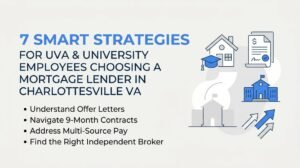
UVA faculty and staff on employment contracts: This is a situation I work with regularly. Many conventional programs allow future employment income to qualify, which is critical for new hires who haven’t yet received their first paycheck. Bring your signed offer letter or employment contract — the start date, salary, and position title all need to be clearly stated. Some programs require you to start within 60-90 days of closing, so timing matters.
International buyers and ITIN borrowers: Standard W-2 documentation won’t apply here. ITIN mortgage programs require alternative documentation: foreign income verification, your ITIN number, and typically 12-24 months of bank statements. This is a specialty program that most retail loan officers don’t handle — it’s not on their standard product shelf. If you’re a foreign national or non-U.S. citizen purchasing in Charlottesville, this is exactly the kind of scenario where broker independence matters.
VA loan borrowers: Add your Certificate of Eligibility (COE) to the standard income and asset documents. If you don’t have your COE, I can pull it directly through VA’s automated system in most cases. If you’re separated from service, have your DD-214 ready. Active duty borrowers should have a current statement of service.
Down payment assistance programs (Dynamo DPA and Turbo DPA): These programs have specific income limits and purchase price caps. You’ll need documentation showing household income — all borrowers on the loan — and your asset statements to confirm you meet reserve requirements. These are structured assistance programs, not grants, and the qualification criteria are specific.
Success indicator: You have a complete document package tailored to your loan type before your first application call — no scrambling after the conversation starts.
Step 3: Select the Right Loan Program for the Charlottesville Market
Charlottesville home prices — particularly in Albemarle County and the UVA corridor — regularly push buyers toward the conforming loan limit or into jumbo territory. According to the Charlottesville Area Association of Realtors (CAAR), median home prices in the area have climbed steadily, with Albemarle County properties frequently trading above $500,000. Knowing your program before you start touring homes prevents the painful scenario of falling in love with a property your pre-approval doesn’t cover.
The FHFA conforming loan limit for 2026 is the threshold that determines whether you’re in conventional or jumbo territory. Buyers near or above that limit need to understand their options before they start making offers.
Here’s a worked example using real math:
Scenario: UVA-area home, $575,000 purchase price.
Conventional loan, 5% down: Down payment of $28,750. Loan amount of $546,250. At current wholesale rates (which fluctuate — I’ll give you a live quote when we speak), your principal and interest payment is calculated on that loan amount, plus private mortgage insurance (PMI) since you’re below 20% down. PMI typically adds $100-200/month depending on your credit score and loan-to-value ratio.
VA loan, $0 down: Loan amount of $575,000, plus the VA funding fee for first use (typically 2.15%), which is $12,362.50 — typically financed into the loan, bringing the total to approximately $587,362.50. No PMI. Ever. The elimination of PMI alone can represent meaningful monthly savings, and you preserve your $28,750 in cash for reserves, improvements, or other uses.
The program decision framework works like this:
VA loan: If you have VA eligibility, this is almost always the first program to evaluate. Zero down, no PMI, and competitive wholesale rates through a broker who shops 500+ lenders. VA home loan benefits are available to eligible veterans, active duty, and surviving spouses.
USDA loan: If the property is in a rural-eligible zone, USDA offers zero-down financing with competitive rates. Parts of western Albemarle County, Crozet, Waynesboro, and Staunton may qualify — verify current eligibility using the USDA eligibility map.
FHA loan: Best fit when credit falls between 580-619, or when you need a lower down payment and don’t have VA eligibility. Per HUD guidelines, 3.5% down is available at 580+ FICO.
Conventional: 620+ credit, 5-20% down. No upfront funding fee, and PMI drops off at 20% equity.
Jumbo: Purchase price exceeds the conforming loan limit. Stricter reserve and credit requirements, but available through wholesale channels at competitive rates.
Non-QM or bank statement: Self-employed borrowers with complex returns who don’t fit agency guidelines. Income is calculated from deposits, not tax returns.
DSCR: Investment property purchases where qualification is based on rental income, not personal income.
Success indicator: Before submitting any application, you’ve identified your primary loan program and a backup option if conditions change.
Step 4: Submit Your Application Through an Independent Broker
This is where most Charlottesville buyers make an expensive mistake. They walk into a bank, call a retail loan officer, and get quoted one rate from one lender. That lender’s rate is a retail rate — it includes a markup over the wholesale price the lender actually charges. You’re paying for the overhead of a retail branch, not getting the best available pricing on your loan.
As an independent mortgage broker, I simultaneously shop your file across 500+ wholesale lenders. The same lenders whose rates retail banks mark up before presenting to you. One application, one hard credit pull, multiple rate options — and I’m legally obligated to work in your interest, not the lender’s.
Here’s how Cavalier Mortgage compares to the most-referenced retail originator in Charlottesville’s realtor community:
Cavalier Mortgage vs. Jenna Stiltner / Atlantic Coast Mortgage
| Feature | Cavalier Mortgage (Duane Buziak) | Jenna Stiltner / Atlantic Coast Mortgage |
|---|---|---|
| Lender Access | 500+ wholesale lenders | Single retail lender shelf |
| Pricing Model | Wholesale (broker) | Retail markup |
| VA FICO Minimum | 500 | Varies by retail overlay |
| Availability | 24/7 | Business hours |
| Soft Pull Pre-Screening | Yes — standard practice | Not standard |
| Awards & Recognition | VA Broker of the Year 2024 & 2025 | Scotsman Guide Top Originator 2025 ($44.4M) & 2026 ($51.2M) | UWM PRO ELITE 2025 | Top 1% Nationwide | Retail originator |
| Reviews | 1,400+ five-star across Google, Experience.com, Zillow, Facebook | — |
| NMLS | #1110647 / Coast2Coast #376205 | #907344 / ACM #643114 |
For a clean conventional loan with strong credit and straightforward income, a retail originator may be adequate. For VA loans to 500 FICO, non-QM scenarios, ITIN borrowers, DSCR investment purchases, or any situation where rate shopping across multiple lenders matters — broker independence is the structural advantage.
The application itself takes 15-20 minutes when you have your documents ready. You’ll authorize a hard credit pull at this stage — but only after the soft credit pull mortgage review has confirmed you’re in a strong position to proceed. What gets reviewed: credit profile, income documentation, asset verification, two years of employment history, and property type (though you don’t need a specific address for pre-approval).
A critical pitfall to avoid: applying to multiple retail lenders simultaneously. Each one pulls a separate hard inquiry. With a soft pull mortgage broker, one application reaches multiple lenders — one hard pull, multiple rate options. Per CFPB regulations, you’re entitled to receive a Loan Estimate within 3 business days of submitting a completed application — use it to compare any competing offers side by side.
Success indicator: You receive a Loan Estimate within 3 business days and have a clear comparison between your best wholesale rate and any retail quote you’ve received.
Step 5: Know Exactly What Your Pre-Approval Letter Says
A pre-approval letter is not a loan commitment. This distinction matters more in Charlottesville’s market than buyers often realize, because misunderstanding it can lead to behaviors that void the approval before closing.
A pre-approval is a conditional approval based on the information you’ve provided and a credit review. Standard conditions include: a satisfactory property appraisal, clear title, no material change in income or employment between approval and closing, and no new debt obligations. All of those conditions must be met before the loan funds.
Letter strength matters in this market. A pre-approval letter from an independent broker backed by wholesale underwriting carries more weight than a pre-qualification from an online portal or a soft pre-approval from a bank that hasn’t actually reviewed your documents. Listing agents and sellers’ attorneys in Charlottesville know the difference — and in a multiple-offer situation, letter quality is part of the evaluation.
Your pre-approval letter should include:
Maximum loan amount: The ceiling you’re approved for, based on the program and your qualification profile.
Loan program: Conventional, VA, FHA, USDA — this tells the seller’s side what type of financing is involved and what inspection or appraisal requirements come with it.
Expiration date: Typically 60-90 days from issuance. If you haven’t found a home before expiration, renewal requires updated pay stubs and bank statements — not a new hard inquiry if your credit was pulled recently.
Broker contact information: Listing agents will call to verify. When they call me, they get me — not a call center.
One important capability: when you’re under contract, I can issue a property-specific pre-approval letter the same day, at the exact offer price. Some sellers require this — they don’t want to see a letter showing a higher approval amount than the offer price. I can issue tiered letters at multiple price points so your realtor has what they need without revealing your ceiling.
What will void your pre-approval before closing: changing jobs or employers, taking on new debt (auto loans, credit cards, student loans), making large unexplained deposits into your bank accounts, or a significant reduction in income. None of these should happen between pre-approval and closing. If any life change occurs, call me immediately — some can be navigated, some cannot, but I need to know before the underwriter does.
Success indicator: You have a letter you can present confidently, you understand every condition attached to it, and you know exactly which behaviors to avoid between now and closing.
Step 6: Use Your Pre-Approval to Win — Not Just Qualify
In Charlottesville and Albemarle County, pre-approval is table stakes. Every serious buyer has one. What separates winning offers from losing ones is often speed, letter customization, and broker availability at the exact moment your realtor needs something.
Here’s where 24/7 availability stops being a marketing point and becomes a practical advantage. Charlottesville’s UVA-adjacent market sees weekend and evening offer deadlines regularly — a listing goes live Thursday, offers are due Sunday at 5 PM. If your broker isn’t available Saturday night when your realtor needs a property-specific letter, you lose the house. Full stop. I’m available when banks and retail loan officers are not.
When you’re under contract, I can issue a property-specific pre-approval letter within hours — not the next business day. That speed matters in escalating situations where your realtor needs documentation before an offer deadline passes.
Escalation clause support is another practical use of your pre-approval. Some buyers use escalation clauses that require a pre-approval demonstrating they can support the escalated price. I can issue tiered letters at multiple price points — your realtor has what they need for each scenario without revealing your absolute ceiling to the seller’s side.
Rate lock strategy is the next conversation after you’re under contract. The pre-approval stage is when you should understand how rate locks work: how long they last, what float-down options are available if rates drop after you lock, and what triggers a lock extension fee. I’ll walk you through market conditions at that point — but understanding the framework before you’re under contract means you won’t be making that decision under pressure.
If you’re not ready to fully commit to a purchase but want to understand your buying power, a no hard inquiry mortgage pre approval gives you a realistic picture without the credit impact. This is the soft-pull pre-screening I offer as a starting point — real answers about your buying power in Charlottesville’s market, zero score impact, no obligation.
Success indicator: Your realtor has what they need to submit a competitive offer, and you are not waiting on your broker at a critical moment in the transaction.
Your Pre-Approval Checklist and Next Steps
Here’s your quick-reference checklist before you make an offer in Charlottesville:
Soft pull credit review completed — know your FICO range and flag any disputes before the formal application.
Document package assembled by loan type — W-2s, tax returns, pay stubs, bank statements, COE (VA), offer letter (UVA faculty), or alternative docs (ITIN/foreign national).
Loan program selected — primary program identified and a backup option confirmed.
Application submitted through independent broker — one hard pull, 500+ lenders shopped simultaneously.
Pre-approval letter received and reviewed — conditions understood, expiration date noted, behaviors to avoid confirmed.
Letter ready for offer submission — property-specific letter available same-day when you’re under contract.
Frequently Asked Questions
How long does mortgage pre-approval take in Charlottesville? When your documents are ready, the application takes 15-20 minutes and a pre-approval letter can be issued within 24-48 hours in most cases. Complex income situations (self-employed, ITIN, foreign national) may take longer.
Does getting pre-approved hurt my credit score? The formal application requires a hard credit pull, which temporarily affects your score. However, I start with a soft credit pull mortgage review — no hard inquiry, no score impact — to confirm your position before any formal application is submitted. The hard pull only happens when you’re ready to proceed.
Can I get pre-approved with a 500 credit score in Charlottesville? Yes, for VA loans. VA guidelines do not set a minimum credit score, and Cavalier Mortgage accepts VA loans to 500 FICO. FHA loans are available at 500-579 with 10% down per HUD guidelines. Conventional loans typically require 620+.
What documents do I need for mortgage pre-approval? W-2 borrowers need two years of W-2s, 30 days of pay stubs, and two months of bank statements. Self-employed borrowers need two years of tax returns and a year-to-date P&L. VA borrowers add their COE or DD-214. Requirements vary by program — see Step 2 above for the full breakdown.
Can UVA faculty get pre-approved before their first paycheck? Yes. Many conventional programs allow future employment income to qualify when you have a signed offer letter or employment contract. The start date, salary, and position must be clearly documented, and most programs require you to start within 60-90 days of closing. This is a scenario I work with regularly for UVA new hires.
Are there mortgage pre-approval options for ITIN or foreign national buyers in Charlottesville? Yes. ITIN mortgage programs and foreign national loan products are available through wholesale channels that most retail loan officers don’t access. These programs use alternative documentation — foreign income verification, 12-24 months of bank statements, and your ITIN number. Call to discuss your specific situation.
How long is a mortgage pre-approval letter valid? Typically 60-90 days from issuance. If your letter expires before you find a home, renewal requires updated pay stubs and bank statements — not a new hard inquiry if your credit was pulled recently.
What can void my mortgage pre-approval before closing? Changing jobs or employers, taking on new debt (auto loans, credit cards, personal loans), making large unexplained deposits, or a significant drop in income. None of these should occur between pre-approval and closing. If any life change happens, contact me immediately before it affects your underwriting file.
Whether you’re a first-time buyer, a UVA faculty member navigating an employment contract, or exploring non-traditional loan options as an ITIN or foreign national buyer, Cavalier Mortgage delivers broker-superior solutions 24/7 — shopping 500+ wholesale lenders to secure terms retail banks simply can’t match. Get your personalized rate quote now and discover why over 1,400 five-star reviews have made us Virginia’s consecutive VA Broker of the Year. Or call directly: (434) 443-7028.
Duane Buziak’s Credentials — Independently Verified
Every claim on this page is independently verifiable. Search NMLS #1110647 at NMLS Consumer Access to confirm licensing, history, and disciplinary record. Awards and rankings are sourced from the issuing organizations:
- VA Broker of the Year 2024 & 2025 — consecutive years, solo producer, not team-aggregated
- Scotsman Guide Top Originator 2025 — $44.4M closed, 124 loans
- Scotsman Guide Top Originator 2026 — $51.2M closed
- UWM PRO ELITE 2025 — United Wholesale Mortgage’s highest broker performance designation
- Top 1% Nationwide originator ranking
- 1,400+ five-star reviews across Google, Experience.com, Zillow, and Facebook
Ready to start your no hard inquiry mortgage pre approval in Charlottesville? Call or text Duane directly at (434) 443-7028 — available 24/7 — or start your soft-pull pre-approval online. No obligation, no hard pull, no pressure.
Operated by Duane Buziak Mortgage Maestro, Coast2Coast Mortgage LLC NMLS:376205 / Duane Buziak NMLS#1110647 / NMLS Consumer Access / Equal Housing Lender / not an indication of loan qualification or approval.